

shopify experts can help when your store needs work that goes beyond theme settings, product uploads, or a straightforward app installation. The challenge is choosing the right specialist, defining what you actually need, and understanding a quote before committing your budget.
This guide explains where to find shopify experts in 2026, how to assess their work, and how to run a safer project. Start by separating professional fees from your ongoing store expenses; our guide to Shopify plan pricing and hidden costs can help you build that broader budget.
You will also learn when hiring is unnecessary. A repeatable operational task, such as managing standard returns, may be better handled with an app than a custom development project.
What shopify experts actually do
“Expert” describes several different jobs. A developer who fixes theme code may not be the right person to manage advertising. For a deeper look at what Shopify experts do, compare the work you need with each specialist’s actual experience.
Developers and theme customizers
Developers handle code changes, custom functionality, technical troubleshooting, and integrations. Theme customizers focus on storefront layouts and behavior. If your product page needs functionality your existing theme cannot provide, start with someone who can explain both the technical approach and its maintenance requirements.
Designers and CRO specialists
Designers improve visual presentation, page hierarchy, and usability. Conversion rate optimization specialists investigate friction that may prevent visitors from buying. Ask how they identify problems and evaluate changes, rather than accepting a promise that a redesign will automatically increase sales.
Store setup and migration specialists
These specialists help organize a new store or move an existing business to Shopify. Define which products, customer records, content, and redirects need attention. A migration proposal should explain validation and launch responsibilities, not just describe moving data.
Marketing, SEO and ads specialists
Marketing specialists work on customer acquisition and visibility. Ask which channels they handle and what reporting they provide. Shopify lists many types of shopify professionals in its Partner Directory, but you still need to check whether their experience matches your particular problem.
When to hire shopify experts and when to DIY
Hire when the consequences of a mistake exceed your ability to test and fix it. A useful brief starts with a business problem, such as “customers cannot select the required product configuration,” rather than a vague request to improve the store.
Consider shopify experts when you need help with:
- Custom theme code or functionality unavailable through existing settings.
- A migration involving important data, URLs, and launch coordination.
- Complex integrations that must exchange information reliably.
- Shopify Plus checkout requirements that need technical assessment.
- A substantial redesign involving design, development, and testing.
You can often handle theme settings, product entry, navigation changes, and standard app installation yourself. If you are starting from scratch, follow a structured process to build a website with Shopify yourself before paying someone to perform basic setup.
For uncertain tasks, request a small discovery engagement first. Ask for a diagnosis, recommended options, and an implementation estimate. This gives you a clearer decision without committing to a full build before the problem is understood.
Where to find shopify experts you can trust
The Shopify Partner Directory is a starting point for finding partners whose services match your project. Build a shortlist around relevant experience, communication, and the type of work required. A directory listing does not replace your own checks.

Referrals are another useful route to shopify experts. Ask merchants with similarly sized stores who completed their project, whether the final scope matched the agreement, and how the provider handled problems after launch.
Choose the working arrangement as carefully as the portfolio:
- Freelancer: Direct communication and a focused skill set can suit a clearly defined task. Check availability, backup arrangements, and who handles work outside that specialty.
- Agency: Access to several disciplines can help with larger projects. Confirm who will actually do the work and whether project management is included.
- In-house hire: Useful when your store needs continuous work and internal knowledge. Consider recruitment, management, and the ongoing workload before committing.
Review the stores they built for merchants, not just their own polished website. Ask whether those examples reflect their current team. The best fit among shopify professionals is someone whose delivery model matches your workload, not necessarily the largest provider.
How to vet a Shopify expert’s portfolio
Open several live stores from the portfolio on both your phone and computer. Browse collections, select product variants, add items to the cart, and check the path toward checkout without completing a purchase. Note confusing navigation, broken interactions, and visibly slow pages.
Remember that a live store may have changed since the original project. Ask the candidate what they built, when they worked on it, and which parts other people handled. Strong shopify experts can explain their contribution without taking credit for an entire store.
Request two or three references from merchants with comparable store size or project complexity. Ask those merchants:
- Was the scope clear before work started?
- How were delays, revisions, and additional costs handled?
- Did the handoff make the store manageable afterward?
- Would you hire the same provider for a similar project?
Read reviews for recurring patterns rather than treating one positive comment as proof. Repeated complaints about missed communication deserve investigation, even when the finished designs look attractive.
For a larger commitment, use a small paid task to assess shopify experts. Choose something bounded, such as diagnosing one layout issue. Evaluate the questions they ask, their explanation, and whether they deliver what was agreed.
What shopify experts cost
Rates vary widely, so there is no reliable universal price for your project. Compare pricing models and deliverables instead of looking for a single benchmark. Most proposals use hourly billing, a fixed project fee, or a monthly retainer.
- Hourly: Suitable for troubleshooting or work with uncertain scope. Agree on an initial time allowance, reporting, and approval before exceeding it.
- Fixed-price project: Useful when deliverables are clear. Specify revision limits, acceptance criteria, and how changes affect the price.
- Monthly retainer: Appropriate for ongoing work. Clarify included capacity, priorities, response expectations, and treatment of unused time.
Quotes from shopify experts depend on scope, custom code versus theme settings, urgency, region, experience, revisions, and ongoing support. An urgent integration project is not comparable to a scheduled adjustment using existing theme controls.

Collect two or three itemized quotes against the same written brief. Ask each provider to separate discovery, design, development, testing, launch, and support where relevant. Require an explicit list of exclusions so that a low headline price does not hide essential work.
Platform expenses remain separate: your Shopify plan, apps, and any paid theme need their own budget. Also reserve room for approved changes and post-launch fixes outside the agreed scope. Compare total responsibility and maintainability, not just the smallest initial invoice.
Questions to ask before you hire shopify developer services
Use the same questions with every shortlisted provider. Written answers make it easier to compare shopify experts and identify gaps before signing. If you are still deciding what kind of engagement you need, review these considerations for choosing Shopify development services.
- How will you investigate the problem? Ask what information they need before recommending a solution.
- What is the timeline? Identify milestones, dependencies, and decisions that could delay delivery.
- Who will do the work? Clarify subcontracting and who is accountable for technical quality.
- Will you use a duplicate or unpublished theme? Ask how they will protect the live store.
- How will testing work? Agree on devices, browsers, and the customer journeys they will check.
- What happens if bugs appear after launch? Define the support window and distinguish defects from new requests.
- Who owns the code and project assets? Get ownership and any licensing restrictions in writing.
- What documentation will you provide? Request operating instructions and notes on custom changes.
- How will we communicate? Set tools, update frequency, and a clear escalation contact.
- What happens if we change themes? Ask which customizations would need rebuilding or transferring.
Before you hire shopify developer support, check that the answers describe an actual process rather than simply saying everything is included.
Red flags when you hire shopify expert help
Warning signs are often about accountability rather than technical vocabulary. Reliable shopify experts should welcome reasonable questions about security, scope, and evidence of previous work.
- Requests for your owner password: Use appropriate collaborator or staff access instead.
- No written scope: Verbal promises leave deliverables and revisions open to dispute.
- Guaranteed sales or rankings: Treat guaranteed commercial outcomes with caution.
- No live examples: Ask for suitable evidence of relevant work.
- Refusal to provide references: Investigate why before proceeding.
- Unnecessary complexity: Question proposals that jump straight to multiple apps or custom builds without assessing simpler options.
- Vague pricing: Avoid agreements that do not explain billing, exclusions, or approval for additional work.
You do not need to accuse a provider of wrongdoing. Ask for clarification. If important answers remain vague, move to another candidate.
How to set up the project so it goes smoothly
Before commissioning custom design, check whether one of the available free Shopify themes already provides a suitable starting point. Paying to recreate existing functionality adds cost without necessarily solving a business problem.
Give shopify experts access through Shopify collaborator or staff accounts, with permissions appropriate to their tasks. Never share the owner password. Review access when the work ends, and remove anything no longer required.
For theme work, start in a duplicated or unpublished theme. Agree on how changes will be reviewed, who can publish them, and what happens if the launch introduces a serious problem. Other types of work may need a separate testing arrangement.
Define milestones around deliverables rather than vague progress updates. For example, “product-page changes ready for review” is more useful than “development mostly complete.” Assign someone on your side to provide consolidated feedback.
Write acceptance tests before work begins. A product-page project might require readable mobile layouts, correct variant selection, working add-to-cart behavior, and no unexpected changes to existing content.
When you hire shopify expert help, include handoff requirements in the agreement. Request documentation, a walkthrough, and clear post-launch support terms. Good shopify professionals should leave you knowing what changed and how to operate it.
Tasks you can handle with an app instead of hiring shopify experts
Many repeatable operations tasks do not justify a custom build. Before you hire shopify developer services, check whether an existing app covers the workflow you need. Returns and exchanges are a useful example: standard processes often need configuration rather than bespoke code.
Yanet Returns & Exchanges helps merchants manage customer returns and exchanges from one place. Customers submit requests through a customer-facing Return Portal, while store owners review and manage those requests in a merchant dashboard.
The app lets you create policies and rules, define return and exchange reasons, and offer different refund and exchange solutions. It also supports managing return shipping and carriers, sending email notifications, customizing the customer return experience, and supporting multiple languages.
For the customer-facing side, our guide to a self-service returns page explains the role of a dedicated portal. Map your policy first so the options customers see match what your business can actually fulfill.
Instead of asking shopify experts to build a standard returns workflow immediately, start with this setup sequence:
- Open Yanet Returns & Exchanges from Shopify Admin.
- Open Return Page to enable the customer-facing portal.
- Configure return and exchange options, return methods, refund methods, reasons, and rules.
- Configure shipping settings if you use return shipping, then set up notifications.
- Under Settings > Setup the Portal, adjust the portal’s presentation and availability.
- Test the complete customer return flow before publishing, as Yanet recommends, then add the Return Page to your store navigation.
In Settings > Setup the Portal, you can enable or disable the portal, upload one or more banners as a single image or auto slider, change the font and button color, and show a return policy link.
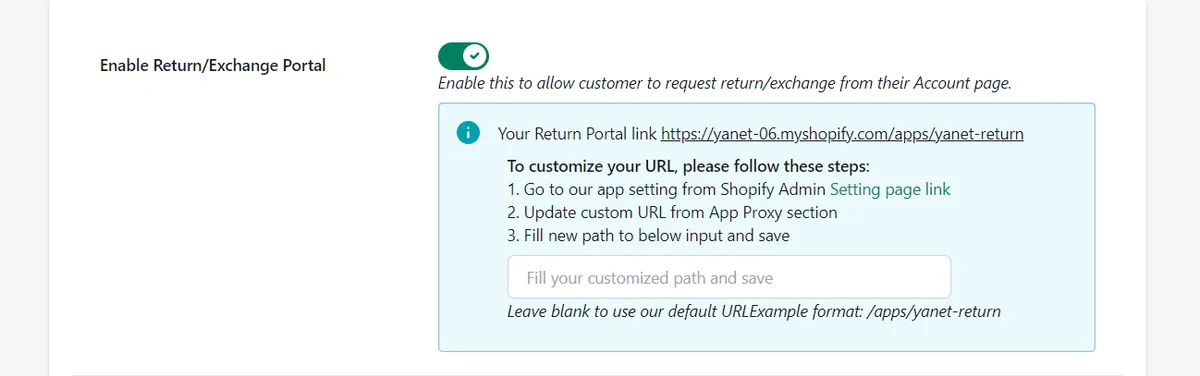
You can also analyze return activity and export return and exchange data. Automated return approvals are available on eligible plans. These capabilities support standard operations, but genuinely custom storefront or backend logic may still justify paying shopify experts.
Conclusion
Hiring shopify experts works best when you start with a specific problem and clear acceptance criteria. Use the Partner Directory and merchant referrals to find candidates, verify their role in live projects, and compare two or three itemized quotes against the same scope.
Ask about testing, ownership, documentation, and post-launch support before agreeing to the work. Give access safely, keep theme changes away from the live storefront until approved, and make sure someone owns the final handoff.
Finally, separate custom development from routine operations. Try Yanet Returns & Exchanges when your priority is managing standard returns and exchanges through a customer portal and merchant dashboard. Save specialist development work for requirements that genuinely need a tailored solution.
FAQ
How do I find a Shopify expert?
Start with the Shopify Partner Directory and referrals from merchants with similar needs. Review live projects, confirm the provider’s exact role, request references, and consider a small paid task before committing to a larger project.
How much does it cost to hire a Shopify developer?
Costs depend on the pricing model, project scope, experience, urgency, and support requirements. Request two or three itemized quotes based on the same written brief, and keep platform, app, and theme expenses separate.
Should I hire a freelancer or an agency?
A freelancer can suit a focused task with clear requirements. An agency may suit projects needing several disciplines and coordination. Compare relevant experience, availability, accountability, and handoff quality rather than choosing by business size alone.
Can I manage my store without hiring Shopify experts?
Yes. Many merchants handle products, theme settings, navigation changes, and standard app setup themselves. Hire specialist help when technical complexity, project risk, or genuinely custom requirements exceed what you can confidently manage and test.